
Budesonide formoterol Inhaler
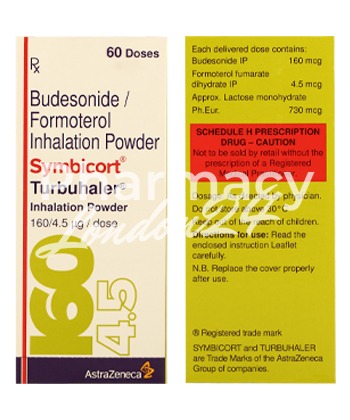
In stock
100/6mcg · 200/6mcg · 400/6mcg · 160/4.5mcg
from 34,47 £
In brief
- Budesonide/formoterol is a combination inhaler: an inhaled corticosteroid to calm airway inflammation plus a long-acting bronchodilator to keep the airways open.
- Listed in four strengths, 100/6, 160/4.5, 200/6 and 400/6 micrograms, with one, two or three inhalers per order.
- In the UK it is prescription-only (POM) and sold as Symbicort Turbohaler, DuoResp Spiromax and similar brands, so your prescriber chooses the strength and regimen.
Budesonide/formoterol inhaler: two medicines in one device
Budesonide/formoterol pairs two active ingredients that work in different ways. Budesonide is an inhaled corticosteroid; used regularly, it reduces the swelling and mucus in the lining of the airways. Formoterol is a long-acting beta-2 agonist that relaxes the muscle around the airways, and it begins to act within a minute or two of inhalation. Putting them in one inhaler means a single device supplies the preventer and the bronchodilator together, which many people find easier to keep up with than two separate ones. Budesonide/formoterol is a maintenance treatment; it is not a rescue medicine unless your prescriber has set it up that way.
What the UK SmPC says it is for
The Symbicort Turbohaler SmPC covers budesonide/formoterol in regular treatment of asthma where an inhaled steroid with a long-acting bronchodilator is appropriate, either when a steroid plus an as-needed reliever has not been enough or when both are already keeping control. It is not meant for the first management of asthma. The higher-strength Symbicort 400/12 is also licensed for symptomatic treatment of COPD in adults with an FEV1 below 70% of predicted and a record of exacerbations despite regular bronchodilators. Children aged 6 and over are covered by Symbicort Turbohaler 100/6 for asthma, but not younger children.
Strengths and packs on this listing
Four strengths are offered: 100/6, 160/4.5, 200/6 and 400/6 micrograms, each in packs of one, two or three inhalers. In the UK, Symbicort Turbohaler comes as 100/6, 200/6 and 400/12, while DuoResp Spiromax comes as 160/4.5 and 320/9, so some strengths here match a UK product and others do not; 400/6 has no direct UK counterpart. The inhalers sent are imported, not UK-licensed packs, and the device and leaflet may differ from the UK versions. Always read the leaflet and learn the technique of the device in your hands, as budesonide/formoterol only works if it reaches the lungs.
Dosing described in the SmPC
For Symbicort Turbohaler in adults with asthma, the maintenance-only regimen with the 100/6 and 200/6 strengths is one or two inhalations twice daily, and some adults need up to four twice daily (with 400/12 it is one inhalation twice daily, up to two twice daily if prescribed), while a separate fast-acting reliever is kept for symptoms. With the maintenance and reliever approach, available for the 100/6 and 200/6 strengths in people of 12 and over, there are two inhalations daily plus extra puffs as needed; no more than six should be taken on any one occasion, the total should not exceed 12 a day for a limited period, and over eight a day calls for medical advice. A separate 100/6 regimen with its own limits exists for children aged 6 to 11. For adults with COPD, 400/12 is one inhalation twice daily. For maintenance-only treatment, children aged 6 to 11 use the 100/6 strength, one or two inhalations twice daily. Do not stop suddenly, and rinse your mouth with water afterwards to lessen the risk of thrush.
Cautions and interactions
Allergy to budesonide, formoterol or the lactose carrier (which contains traces of milk protein in Symbicort) is a contraindication. The inhaler should not be started during a flare-up or while asthma is getting rapidly worse. More caution is needed with thyroid overactivity, phaeochromocytoma, diabetes, untreated low potassium and serious heart disease, because formoterol can lengthen the QT interval. Beta-blockers, including eye drops, can blunt formoterol. Strong CYP3A4 inhibitors such as ketoconazole, itraconazole, clarithromycin and ritonavir increase the steroid exposure. Diuretics, xanthines and steroids taken by mouth may lower potassium further, and medicines that prolong the QT interval can add to the risk. Tell your prescriber about every medicine you use alongside budesonide/formoterol.
Side effects to watch for
Common effects include thrush in the mouth and throat, a hoarse voice, throat irritation, cough, headache, tremor and palpitations. Rarely, an inhaler can cause paradoxical wheeze straight after a dose; if so, stop it, use a fast-acting reliever and get urgent advice. Long-term high-dose inhaled steroids can have whole-body effects, and growth should be monitored in children. Call 999 or go to A&E if breathing becomes very difficult or a reliever does not help. Your GP or asthma nurse decides which strength suits you and revisits the choice as your control changes.



