
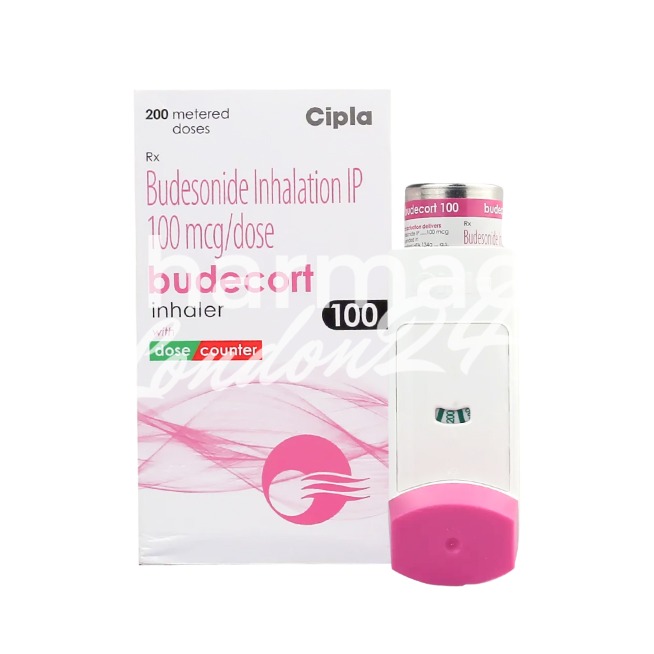
Budecort
In brief
- In our pharmacy, you can buy Budecort without a prescription, with delivery in 9–21 days throughout the United Kingdom. Discreet and anonymous packaging.
- Budecort is intended for the treatment of asthma. The drug is a corticosteroid that reduces inflammation in the airways.
- The usual dosage of budecort for asthma maintenance is 200–800 μg/day, and for severe asthma, nebulised forms are used at 0.25 mg to 1 mg per 2 ml.
- The form of administration includes inhalers and nebulised solutions.
- The effect of the medication begins within 5–15 minutes for inhaled forms.
- The duration of action varies but typically lasts 12–24 hours, depending on the form.
- The most common side effect is oral candidiasis (thrush) for inhaled forms.
- Would you like to try Budecort without a prescription?
Basic Budecort information
- INN (international nonproprietary name): Budesonide
- Brand names available in the United Kingdom: Budecort (Cipla) is not a UK-licensed brand; licensed UK budesonide brands include Pulmicort (inhaler, nebuliser suspension) and Rhinocort (nasal spray)
- ATC code: R03BA02
- Forms and dosages: Inhalers (100 and 200 micrograms per dose), nebuliser suspension (Respules)
- Manufacturers in the United Kingdom: AstraZeneca (Pulmicort); Cipla (Budecort)
- Registration status in the United Kingdom: Budecort is not licensed in the UK; licensed budesonide inhalers are prescription-only
- OTC / Rx classification: Prescription-only medicine (POM)
Everyday use and best practices
Establishing a consistent routine can significantly impact the effectiveness of Budecort in managing asthma symptoms. Many patients find that taking their morning dose aids in controlling daytime symptoms, while an evening dose can help manage overnight discomfort. However, individual schedules might influence the best times for taking the medication, so it’s essential to find a timing that fits comfortably into daily life.
Taking with or without meals
Budecort is inhaled, so it is not affected by food intake. It is good practice to rinse your mouth with water and spit it out after each dose, to reduce the risk of thrush and a hoarse voice.
Safety priorities
Understanding who should avoid Budecort is crucial. It is not recommended for individuals with hypersensitivity to budesonide or those suffering from certain infections, such as active tuberculosis. The MHRA provides important safety warnings for vulnerable populations, including children and the elderly. Consultation with healthcare providers will ensure that any potential risks are effectively managed.
Activities to limit
Some patients report side effects, such as dizziness, which may impair their ability to drive safely. It is advisable for anyone starting Budecort, or those adjusting their dosage, to evaluate their response to the medication before engaging in activities that require full concentration. Additionally, checking with healthcare providers regarding occupational safety in physically demanding jobs is recommended.
Dosage and adjustments
According to NHS guidelines, standard dosages for Budecort depend on the condition being treated. For asthma, inhaled budesonide is typically prescribed at dosages ranging from 200–800 micrograms daily, in divided doses. Budesonide is also available as respules for nebulisation, which are particularly useful for children who cannot use an inhaler.
Special cases
When considering Dosage Adjustments, particular care must be taken for the elderly and individuals with liver or renal impairment. Starting at lower doses is advisable, especially with the elderly due to increased sensitivity to medications. Regular monitoring will help manage any side effects effectively and ensure treatment efficacy.
What’s inside and how it works
Ingredients overview
Budecort's effectiveness stems from its active ingredient, budesonide, an inhaled corticosteroid. Additionally, the formulation contains inactive ingredients which support the delivery mechanism. Patients with sensitivities should be cautious, as common allergens may exist within the compound's excipients.
Mechanism basics explained simply
Understanding how budecort operates can be simplified. As a corticosteroid, budecort reduces inflammation in the airways, a major concern in asthma. It mimics our body's natural processes aimed at controlling inflammation, providing relief and improving lung function over time.
Main indications
Uses
Budecort contains budesonide, which is licensed in the UK as an inhaled preventer treatment for asthma. Budecort itself is not a UK-licensed brand. Budesonide nasal sprays are used for allergic rhinitis.
Off-label uses in UK clinics
While budecort is primarily prescribed for its indicated uses, some clinicians may suggest off-label applications. These may include treating conditions not officially approved, yet benefiting from the anti-inflammatory properties of corticosteroids. Such practices should be approached carefully, remaining within the bounds of medical advice.
Interaction warnings
Food interactions (alcohol, tea/coffee)
Budecort is inhaled and is not known to interact with food, alcohol, tea or coffee.
Drug conflicts
Interactions with other medications are crucial to discuss with healthcare providers when using budecort. Potential conflicts exist, particularly with certain antifungal agents (such as ketoconazole and itraconazole), which can increase the amount of budesonide in the body. Clear communication about all concurrent medications is essential for safe and effective treatment.
Alternative choices
For patients considering alternatives to Budecort, a range of corticosteroids prescribed by the NHS can be evaluated. Alternatives include popular choices such as Fluticasone (Flixotide), Beclometasone (Qvar), and Mometasone (Asmanex). Each has its pros and cons, which can guide patients in making informed decisions.
Pros/Cons Checklist:
- Fluticasone: Highly effective for severe asthma, but may cause systemic side effects.
- Beclometasone: Widely used, but doses are not directly interchangeable with budesonide.
- Mometasone: Offers a variety of formulations, taken once daily in some cases.
Before switching or starting new medication, discussing these alternatives with a healthcare provider is essential to determine the best option based on individual needs and underlying conditions.
Regulation snapshot
Budecort is not a UK-licensed brand. Budesonide inhalers licensed by the Medicines and Healthcare products Regulatory Agency (MHRA), such as Pulmicort, are prescription-only medicines (POM) in the UK.
The NHS prescribes budesonide inhalers for patients diagnosed with asthma.
Frequently asked questions
1. What is Budecort used for?
Budecort is used for managing asthma, helping to reduce inflammation in the airways and prevent symptoms.
2. How should Budecort be taken?
It is essential to follow healthcare provider instructions. Typically, Budecort comes in inhalers or respules, and correct inhalation techniques are crucial for effective delivery.
3. Are there any side effects?
Common side effects may include mouth irritation or candidiasis. More severe side effects are rare but can occur, requiring immediate medical attention.
4. Can I use Budecort with other medications?
Yes, Budecort can be used alongside other asthma or COPD medications, but it’s important to consult a healthcare professional for tailored treatment regimens.
Guidelines for proper use
Using inhalers or respules correctly is vital for optimal effectiveness. Here are critical techniques to follow:
- Shake the inhaler gently before use.
- Exhale fully before placing the inhaler in the mouth.
- Inhale slowly and deeply while activating the inhaler.
- Hold the breath for about 10 seconds to ensure proper medication deposition.
Additionally, patients are encouraged to consult NHS resources for ongoing support and education about asthma and COPD management. Local pharmacies can also provide valuable advice on inhalation techniques and medication adherence.
City delivery times
| City | Region | Delivery Time |
|---|---|---|
| London | Greater London | 9–21 days |
| Birmingham | West Midlands | 9–21 days |
| Manchester | North West | 9–21 days |
| Glasgow | Scotland | 9–21 days |
| Newcastle | North East | 9–21 days |
| Sheffield | South Yorkshire | 9–21 days |
| Liverpool | North West | 9–21 days |
| Bristol | South West | 9–21 days |
| Nottingham | East Midlands | 9–21 days |
| Cardiff | Wales | 9–21 days |
| Leeds | West Yorkshire | 9–21 days |
| Coventry | West Midlands | 9–21 days |
| Bradford | West Yorkshire | 9–21 days |
| Southampton | South East | 9–21 days |
| Aberdeen | Scotland | 9–21 days |



